

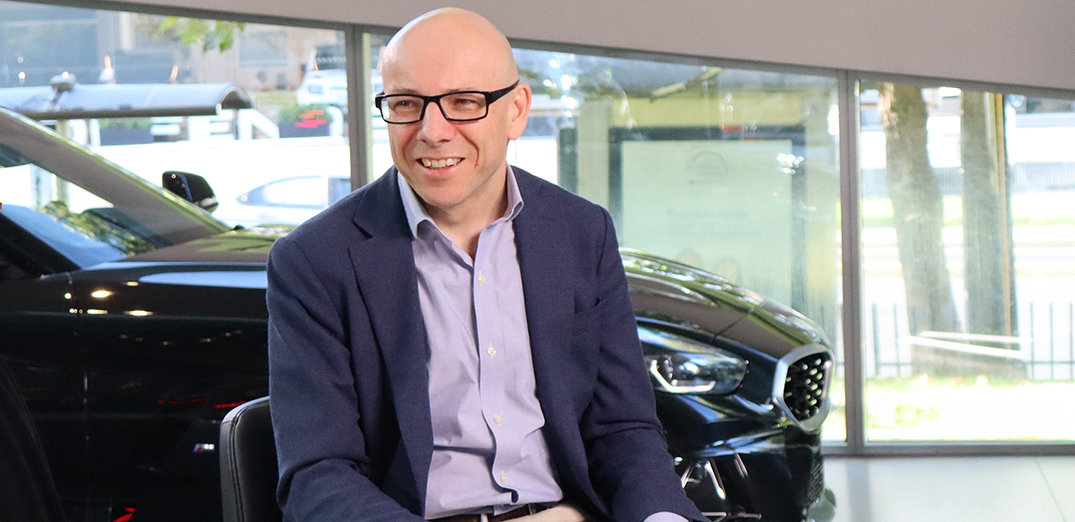
- The automotive distributor representative is leading the regional race for new energy vehicles (NEVs) from Chile. The goal is to stay ahead of market trends, with a strategy focused on training technicians and salespeople to reduce consumer anxiety.
The goal is set, and the horizon is clear. Mike Bowers, CEO of Inchcape Americas, has a clear vision of the path the automotive industry—and Chile in particular—must take towards the transformation of the vehicle fleet by 2035, when only new energy vehicles (NEVs) are expected to be imported. This is not just a technological shift but a profound transformation in how people move, consume, and make decisions about mobility.
Based in Santiago—a city where he lives and from which he leads operations across 14 countries in Latin America and the Caribbean—Bowers observes a process advancing at different speeds but with an unequivocal direction.
— How do you see the transition to new energy vehicles in the region?
“In some markets, like Hong Kong, nearly 80% of sales are already electric. In Latin America, the pace is slower, but the trend towards new energy vehicles is clear and consistent.”
To better understand the factors behind this uneven pace, Inchcape, together with Ipsos, commissioned the study *Drivers of Change*, conducted in six countries in the region, including Chile.
— What did the study reveal about consumers?
“What we understood very clearly is that people place a very high value on personal mobility. It improves their quality of life, provides freedom, access to work, and the ability to carry out their activities. And when we look at attitudes towards new energy vehicles, the main driver is environmental concern.”
According to the study, more than 30% of consumers in the region state that their next vehicle will be a new energy vehicle: “But the transition doesn’t happen on its own. We need to ensure we are ready when the market moves forward,” says Bowers. “We want to be at the forefront of the transition,” he emphasises.
Inchcape, the world’s leading independent automotive distributor, decided not to wait for the market to push forward on its own. Bowers explains that their strategy has been to anticipate: train, educate, and support.
The logic behind this strategy is clear: as long as barriers such as cost, lack of charging infrastructure, or the so-called “range anxiety” persist, information and support will be decisive in consumer decision-making.
— What are the main obstacles you’ve identified?
“Cost, charging infrastructure, and range anxiety (caused by battery life). These are the three major barriers that consistently appear.”
— What are you doing specifically to support the process?
“We are training our technicians and salespeople so they can handle the details of battery electric vehicles and have informed conversations with customers about the best options for their needs.”
At the same time, Bowers maintains that the expectation is for the public sector to advance incentives for purchasing new energy vehicles and for private players—mainly international ones—to deploy the necessary charging infrastructure as the market matures.
“In most markets, charging infrastructure ends up being provided by the private sector when there is a clear signal that the transition is sustainable,” explains the executive. “This has been the comparative experience in other regions of the world,” he adds.
Chile as a strategic hub
It is no coincidence that Mike Bowers observes the landscape from Chile. The country is Inchcape’s main market in the region and its regional base. Of the more than 6,500 colleagues the company has in the Americas, nearly 2,000 are in Chile. The regional team is based here, and many of the group’s strategic initiatives are tested in this market.
“Chile is our largest market and the logical place to have the regional headquarters,” summarises Bowers. In a highly competitive market—with more than 120 brands and models—Inchcape leads with approximately 24% market share, a position the company aims to consolidate and expand, particularly in the new energy vehicle segment.
Under its operation, the company already holds 17% of the regional NEV market in 2024, reaching 44% in Chile. It recently inaugurated an EV Centre in Costa Rica and new logistics centres in Peru and Colombia.
Chile’s significance fits into a broader context. “We are organised into three regions: Asia Pacific, Europe and Africa, and then the Americas. If we look back to 2024, the Americas represent 37% of revenue and 46% of profit before tax. So, its contribution to the entire group is truly critical,” he explains.
— What plans do you have to strengthen your presence?
“Our ambition over the next five years is to double the size of our business here in the Americas. We have a great platform, a great business, but we see much more opportunity. It is in the Americas where we are most relevant to our OEM partners, the brands.
We are truly relevant to them in markets that are too small or a bit more complex for them to operate on their own. Whether we think of Chile, Argentina, Peru, Colombia, Ecuador, or across Central America and into the Caribbean, all of these are significant strategic opportunities for us.”
A diverse and long-term portfolio
Globally, Inchcape works with around 60 manufacturers, prioritising long-term relationships with brands that—in Bowers’ words—“stand the test of time.”
— How do you select brands for each market?
“We have global relationships with around 60 different OEM brands. Many of these relationships are truly long-term, where we have worked with these brands for many years in different markets. We choose to work with winning brands that stand the test of time, that have longevity. We select with long-term success in mind and partnerships that can endure.”
In Chile, this strategy has translated into the addition of new NEV brands from the Changan group, such as AVATR and Deepal, alongside maintaining a portfolio that spans from mass-market to premium segments. They have also incorporated commercial entities such as Derco, Ditec, and ITC Group, giving them distribution rights for Porsche, Volvo, Jaguar Land Rover, and Suzuki in Chile.
Diversity is not contradictory but part of the vision behind the Accelerate+ growth strategy, which has also ventured into adjacent categories, such as premium motorcycles, with Harley-Davidson as a flagship.
“The two major elements of our global Accelerate+ strategy are scaling and optimising. Because when we think about the roadmap, we think about passenger cars, of course, but we also consider adjacent categories. Within these adjacent categories, we see trucks and machinery as a very important growth driver and a good opportunity for us in the region,” he explains.
A journey marked by sustainability
Bowers’ perspective combines this business logic with a personal trajectory that is somewhat unconventional in the industry. A trained lawyer, he joined Inchcape in 2015 as Group General Counsel and was a key figure in the mergers and acquisitions strategy that transformed the company into a global player.
Later, as Chief Sustainability Officer, he integrated the environmental and social agenda into the heart of the growth strategy.
Today, from his regional leadership role, that combination remains present. It is no coincidence that when he talks about mobility, he also speaks from personal experience. In Santiago, he drives a BMW X3—“practical for the city and with space for the bike,” he says—and fondly recalls his first car: a small Suzuki he drove on back roads in Greece in his early twenties.
Personal stories coexist with larger figures but reinforce a central idea: mobility matters because it directly impacts quality of life. Even more so in Latin America, where owning a car remains a symbol of autonomy and opportunity, and especially now, as the transition to cleaner technologies becomes irreversible.